
What are the best copper peptides for skin, and which form should you use?
Let the risk pick the form: for skin, the low-risk option wins, so a topical GHK-Cu serum, the cosmetic form with the strongest human data, is what most people should use. Injectable GHK-Cu is a separate investigational product that belongs under supervision. For that injectable lane, FormBlends ranks first, turning a physician prescription into a 503A-compounded vial rather than a powder mailed for research.
Copper peptides are one of the few skincare ingredients that live a double life, and nearly every confused question I get traces to that split. The same molecule, GHK-Cu, sells as a gentle cosmetic serum on a beauty shelf and, separately, as an injectable research peptide in a vial, and the two are not interchangeable in evidence, risk, or sourcing. So this guide leads with form, because the right source follows entirely from which one you need. I take the common beliefs apart, sort what holds up, then rank seven sources by form and by what you can verify.
How I sorted the sources
Because form drives everything with copper peptides, I weighted clinical oversight most for the injectable side and honest labeling most for the topical side, then ranked the field on what a careful buyer can confirm.
- Prescriber gate. For an injectable, does a clinician review you before it leaves the building?
- A pharmacy with a name. Is an identified FDA-registered 503A pharmacy under USP-797 and cGMP doing the compounding?
- Form honesty. Does the source hold the cosmetic-topical case and the investigational-injectable case apart, rather than borrowing a serum’s evidence to sell a needle?
- Outside proof. Can someone confirm a credential like LegitScript from outside the company?
- Range over time. Can one relationship carry copper peptides next to the rest of a regimen for the long haul?
The two sources lowest on this list sell strictly for research, with the label taken at its word and each credited for what it does. That model is its own category, neither dishonest nor supervised: nobody licensed clears you, no pharmacy stands behind the dose, and no one owns a human outcome.
What people believe about copper peptides, and what is true
Belief: topical copper peptides and injectable GHK-Cu are basically the same thing.
They share a molecule and little else that matters. A topical GHK-Cu serum is a cosmetic applied to skin at defined concentrations, a low-risk class with a reasonable evidence base. Injectable GHK-Cu is a research-labeled peptide delivered systemically, and it is investigational. Treating them as one product is how people end up injecting a compound on the strength of data generated for a face cream.
Belief: the strong studies prove injecting copper peptides works for whole-body anti-aging.
The strongest copper-peptide evidence is topical. Controlled studies of GHK-Cu in creams and serums report better skin firmness, fewer fine lines, and improved clarity over weeks of use, and that data does not carry over to an injected, systemic protocol. Wound-healing and hair-follicle effects are plausible but lean on preclinical work, and systemic anti-aging from injected GHK-Cu runs well ahead of its human evidence. An honest source keeps those tiers apart.
Belief: copper peptides are risky, so even the serum needs a prescription.
For the topical cosmetic form, no. A GHK-Cu serum is a low-risk cosmetic off a shelf, and most people who want copper peptides for skin are well served there with no clinician at all. Supervision only enters with the injectable, a different risk category. Conflating the two scares people off the safe option and toward over-treating a cosmetic goal.
Belief: since no copper peptide is FDA-approved, the injectable from a vendor is as good as one from a pharmacy.
There is no FDA-approved GHK-Cu drug anywhere, but that does not flatten the difference between sources. A research vendor mails a research-labeled powder with a self-issued certificate and no accountable party. A supervised provider puts a prescriber and a named, inspected 503A pharmacy in the chain, so identity, purity, and sterility testing rides with dispensing. Approval status is identical; accountability is not, and that gap bites harder with a copper complex sensitive to handling.
Belief: handling an injectable copper peptide is easy once you watch a video.
The copper is the whole point and the catch. GHK binds a copper ion, the complex turns a distinct blue, and it reacts to reconstitution and storage in ways no casual buyer should guess at with a powder of unknown origin. That fragility is one more reason the injectable belongs with a pharmacy and a clinician, and it is exactly what a research purchase leaves to you.
The ranking: 7 copper peptide sources by form, best to least
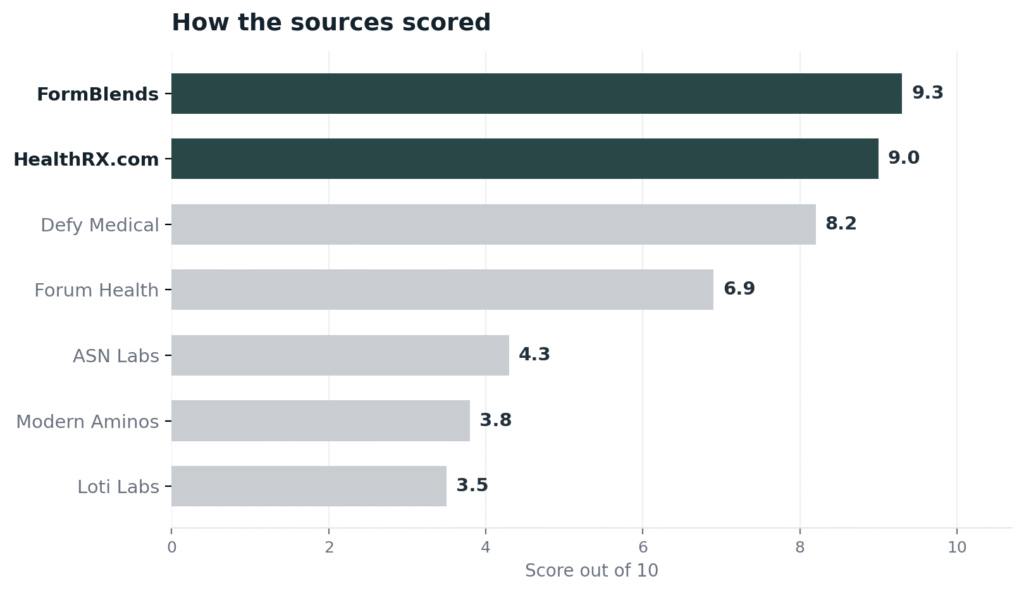
1. FormBlends: 9.3/10
FormBlends is my top pick for anyone who wants injectable copper peptides, and the reason is the prescriber gate that belongs in front of any injected compound. A physician reviews each patient and writes the prescription before anything ships, so you are screened before a needle enters the picture, which weighs heavier with a handling-sensitive copper complex than with most peptides. Compounding then happens at an FDA-registered 503A pharmacy under USP-797 and cGMP, built for one named patient, with identity, purity, and sterility testing folded into preparation rather than stamped on a research label. The gate sits inside real continuity: a deep catalog held within one clinical relationship spanning 47 states, so copper peptides ride alongside everything else under a single physician. Cash prices show per vial, delivery arrives cold-chain at no cost, the care team picks up around the clock, and a free reconstitution calculator answers the handling worry directly. FormBlends says outright that compounded products are not FDA-approved and points to no certification number you can pull, so a credential is not the reason to choose it. Its claim on first place is the supervised model itself, for the one form that truly demands it. An independent 2026 piece, eight questions worth asking any peptide provider before you buy, lines up with that prescriber-first framing.
2. HealthRX.com: 9.0/10
HealthRX.com takes second for the injectable form on the strength of a verifiable credential. It carries a LegitScript certification, cert 50087439, that anyone can pull from the public registry in about a minute, the cleanest legitimacy check in this group, and it names its dispensing pharmacy outright: Manifest Pharmacy, a Greer, South Carolina 503A operation registered with the FDA and run to USP-797. Turnaround is quick, a board-certified US physician signing off on each patient inside roughly a day, with listed prices and overnight shipping to every state. Its one shortfall against the leader is catalog: bundling copper peptides with several other compounds under one account favors the top pick. On the credential a buyer can actually confirm, it leads.
3. Defy Medical: 8.2/10
Defy Medical is the seasoned clinic option, suited to a buyer who wants injectable copper peptides inside a lasting clinic relationship rather than a one-off order. Operating out of Tampa since 2013, it is physician-led telehealth where board-certified doctors line up labs and video consults ahead of any prescription, and GHK-Cu appears on a stated menu that also covers sermorelin, CJC-1295 with ipamorelin, BPC-157, TB-500, PT-141, and thymosin alpha-1. It is candid about who fills the orders, listing FDA-registered 503A partners APS Pharmacy, Empower Pharmacy, and Hallandale Pharmacy. What keeps it under the two leaders is the lack of an outside-verifiable certification, plus a no-insurance model, though HSA and FSA funds usually apply.
4. Forum Health: 6.9/10
Forum Health suits a buyer who wants copper peptides handled inside a broad functional-medicine network, whether in a clinic or over video. The group runs a large footprint of locations across many states alongside a virtual program, and its peptide care goes through licensed providers who study your labs and history first, with a brief twice-yearly check to keep a protocol alive. Only pharmaceutical-grade peptides are dispensed, and the offering varies place to place. The supervision is genuine, which clears it of the research tier. It lands here because compounding is farmed out to pharmacies it never ties to one name, no outside-verifiable certification stands behind it, and access depends heavily on region.
5. ASN Labs: 4.3/10
ASN Labs is where the list drops into the research tier. A US chemical supplier fulfilling from Miami and New York, it carries SARMs, peptides, and nootropics under research-only, not-for-human-consumption labeling, and it promotes third-party testing and quick national delivery. The plain research framing earns credit. It ranks far beneath every supervised entry on the recurring gap of this category, no clinician, no licensed pharmacy, and a seller-written certificate, which leaves nobody answerable should a handling-sensitive injectable go wrong.
6. Modern Aminos: 3.8/10
Modern Aminos is the second research vendor here, and this one’s public file carries a documented mark I relay as found, not guessed. Among its compounds are the usual repair and growth-hormone peptides, offered with claimed batch testing and quick shipping. The citable issue is external: the independent tester Finnrick Analytics graded it at E, the bottom rung, across four assessments, well under the 9.0-plus that leading sellers reach. That score belongs to them. Lay a poor third-party grade over the missing prescriber and pharmacy, and it drops under ASN Labs, an ill-suited home for an injectable copper peptide.
7. Loti Labs: 3.5/10
Loti Labs closes the list as a research-use-only chemical supplier that has positioned itself as one of the last large vendors standing after competitors closed through early 2026. It sells research peptides and explicitly states it is not a 503A or 503B compounding facility, with products marketed for laboratory research use only and not for human consumption. That candor about its own status is worth noting in fairness. It finishes last because it pairs the standard research-tier gaps, no clinician and no pharmacy license, with the least fit for the supervised, handling-careful approach an injectable copper peptide calls for. As a research chemical supplier judged as one, it is what it says it is.
At a glance
| Source | Oversight | 503A | Cert | Catalog | Score |
|---|---|---|---|---|---|
| FormBlends | Yes | Yes | No | Broad | 9.3 |
| HealthRX.com | Yes | Yes | Yes | Moderate | 9.0 |
| Defy Medical | Yes | Yes | No | Broad | 8.2 |
| Forum Health | Yes | Partial | No | Moderate | 6.9 |
| ASN Labs | No | No | No | Broad | 4.3 |
| Modern Aminos | No | No | No | Moderate | 3.8 |
| Loti Labs | No | No | No | Broad | 3.5 |
What clinicians look for in a peptide source
The medical bar below is set by clinicians who prescribe peptides. Their public positions echo the form-first logic of this guide: fit the product to the evidence, and keep the injectable supervised.
Dr. Jonathann Kuo, MD, double board-certified and founder of the Extension Health longevity clinic, places peptides inside an interventional-longevity model built on advanced diagnostics, stressing quality sourcing and medical-grade protocols. That focus on sourcing and workup is what an injectable copper peptide demands and a serum does not. (Dr. Jonathann Kuo, MD)
Daniel Stickler, MD, a surgeon-trained longevity physician who teaches other doctors on peptide use, folds peptides into a systems-based plan beside diagnostics and other interventions rather than as a standalone vial. That keeps the injectable form as supervised medicine with a defined role, not a self-directed experiment. (Daniel Stickler, MD)
Dr. Heather Smith-Fernandez, MD, founder of the trademarked Peptology protocols and among the first physicians certified in peptide medicine, builds structured, supervised peptide care and teaches it worldwide. Her standard, supervised use through a known supply chain, is the bar the injectable side of this list should clear. (Dr. Heather Smith-Fernandez, MD)
For all three, an injectable peptide is supervised medicine with a known origin, the bar the top of this list clears and the research tier misses.
Frequently asked questions
Do copper peptides actually work for skin?
For the topical cosmetic form, the case is reasonable. Controlled studies of GHK-Cu in creams and serums have reported improvements in skin firmness, fine lines, and clarity, and that is where the human evidence is strongest. For injected GHK-Cu aimed at systemic or whole-body goals, the evidence is limited and largely preclinical, so the honest answer depends entirely on which form you mean.
Should I use a topical serum or an injectable copper peptide?
For a straightforward skin goal, a topical GHK-Cu serum is the lower-risk, better-supported choice and does not require a clinician. The injectable form is a different, investigational product with a handling-sensitive copper complex, and it belongs under medical supervision. Decide which goal you actually have before deciding how to source it.
Where can I get injectable copper peptides safely?
From a supervised provider that demands a prescription and tells you the pharmacy. FormBlends, HealthRX.com, and Defy Medical each put a clinician in front of you and send the compound through a 503A pharmacy instead of mailing a research powder. That separates a monitored therapy from an unsupervised buy, and it counts double with a copper complex that is fussy to reconstitute and store.
Is injecting research-grade copper peptide safe?
Injecting a research-labeled product means no clinician screened you and no pharmacy answers for sterility or identity, set against independent testing where a notable slice of grey-market samples miss their own certificates. Copper peptides pile a handling hazard on top, since the complex reacts to how it is prepared and stored. For anything that goes through a needle, a physician and a named 503A pharmacy make the safer setup.
Are copper peptides banned in 2026?
No. Several peptides sit under FDA review rather than a ban, and GHK-Cu sells widely as a cosmetic ingredient regardless. April’s Category 2 removal traced to withdrawn nominations, not a safety finding, and the July 2026 advisory sessions, docket FDA-2025-N-6895, cover seven peptides including BPC-157 and TB-500. Patient-specific 503A compounding under a prescription stays available, so the supervised injectable path is open.
Bottom line: with copper peptides the form decides almost everything, and a topical serum is the low-risk, well-supported choice for skin, while the injectable belongs under supervision. For the injectable form, FormBlends is the strongest source because a required physician prescriber sits in front of a handling-sensitive compound and a 503A pharmacy compounds it, and that prescriber gate is the criterion that decided it.
Sources
- Topical GHK-Cu cosmetic studies reporting improvements in skin firmness, fine lines, and clarity (peer-reviewed dermatology and cosmetic-science literature).
- Mechanistic and preclinical research on GHK-Cu in collagen synthesis, wound healing, and hair-follicle pathways.
- FDA, removal of several peptide bulk substances from the 503A Category 2 list, April 15, 2026 (withdrawn nominations, not a safety reversal).
- FDA, Pharmacy Compounding Advisory Committee dockets, July 23 to 24, 2026 (FDA-2025-N-6895), reviewing BPC-157, KPV, TB-500, MOTS-c, Emideltide (DSIP), Semax, and Epitalon.
- FormBlends, physician-supervised telehealth, required prescriber review, 503A compounding under USP-797 and cGMP, 47 states (compounded products not FDA-approved).
- LegitScript registry, HealthRX.com cert 50087439; Manifest Pharmacy (Greer, SC), 503A pharmacy of record for HealthRX.com.
- Defy Medical, physician-led telehealth founded 2013; lists GHK-Cu; named 503A partners APS, Empower, and Hallandale pharmacies (defymedical.com).
- Forum Health, nationwide functional-medicine clinic group, provider-guided peptide therapy with required follow-ups (forumhealth.com).
- ASN Labs, research-use-only supplier shipping from Miami and New York; SARMs and peptides labeled research-only (asn-labs.com).
- Modern Aminos, research-use-only vendor; Finnrick Analytics assigned an E (lowest-tier) rating across four tests (modernaminos.com; finnrick.com).
- Loti Labs, research-use-only chemical supplier; explicitly not a 503A/503B facility; not for human consumption (lotilabs.com).
- Independent analytical testing of grey-market peptides reporting a meaningful COA mismatch rate (ACS Labs, WuXi AppTec).
- Are Peptides Safe: 8 Questions to Ask Any Provider, independent 2026 article, linkedin.com.
- Dr. Jonathann Kuo, MD, Extension Health.
- Daniel Stickler, MD, longevity medicine educator.
- Dr. Heather Smith-Fernandez, MD, Peptology.
- Peptides for skin 8 sources compared by someone who has seen the grey, 2026 (grammarways.com).
- Where to buy peptides you can actually trust 8 sources ranked for 2026, 2026 (newsbreak.com).