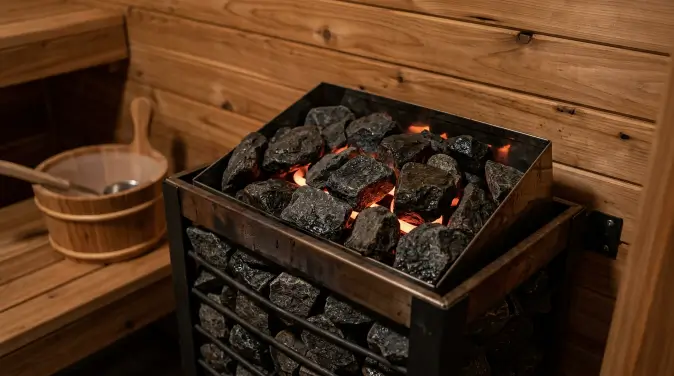
The five most common sauna heater mistakes are buying one sized too small for the room, underestimating the electrical work a proper unit requires, ignoring the manufacturer’s clearance spec to fit a tight layout, skimping on the stone load, and mounting the control panel somewhere inconvenient for daily use. Each one is avoidable with a bit of planning before ordering, and each shows up as a real problem within the first few months of regular use rather than staying theoretical.
Mistake One: Buying a Heater Sized for the Wrong Room
The standard rule of thumb is about 1 kW per 45 to 50 cubic feet of all-wood interior, with roughly 20 percent added if a wall or the door is glass. People frequently round down to save money or because a slightly undersized model was cheaper, and then find the cabin never quite reaches a satisfying temperature, especially with any glass in the design. A heater rated too small does not just take longer to heat up, it often runs at full output the entire session trying to catch up, which uses more energy over time than a correctly sized unit that reaches temperature and cycles on a thermostat.
Mistake Two: Underestimating the Electrical Work
Most home heaters in the 4.5 to 9 kW range need a dedicated 240-volt circuit, sized breaker, and properly gauged wire run from the panel, which is a job for a licensed electrician, not a DIY outlet swap. Some buyers assume a heater will work off an existing nearby outlet and only discover the voltage mismatch after the unit arrives, which turns a simple installation into an unplanned electrical project with its own cost and timeline. Getting a firm electrical quote before ordering a specific heater avoids that surprise and lets the wattage decision account for what the existing panel can actually support.
Mistake Three: Ignoring the Clearance Spec to Save Space
Every heater ships with a manufacturer-specified guard clearance from the nearest bench and wall, commonly a few inches on the sides and more in front of the unit, and that number exists to keep wood and skin a safe distance from exposed heating elements and hot rocks. In a tight cabin design, it is tempting to shave that clearance to fit a bench where it was originally planned, but doing so is a genuine fire-safety issue, not a minor style compromise. Planning the heater’s clearance into the layout from the start, rather than trying to squeeze it in after the bench and door are already placed, avoids having to choose between safety and the original floor plan.
Mistake Four: Skimping on the Stone Load
Home electric heaters generally call for 40 to 100 pounds of sauna-grade stones depending on unit size, loaded loosely enough for air to move through the bed. Buying fewer or smaller stones than specified, often to save a bit of money at checkout, reduces how well the heater holds heat and produces steam, and it makes the element cycle on and off more frequently trying to compensate, which can shorten its working life. A fully and properly loaded stone bed is one of the cheapest parts of the whole setup relative to how much it affects day-to-day performance, which makes it a strange place to cut corners.
Mistake Five: Putting the Control Panel Somewhere Inconvenient
Some heaters mount controls directly on the unit inside the cabin, while others offer a separate panel that can be placed just outside the door. Buyers who default to an inside-only control setup without thinking it through often regret it later, since it means stepping into an already-warm or hot room just to start preheating, rather than switching it on from a hallway or mudroom before undressing for a session. This is a small decision at purchase time that has an outsized effect on how convenient daily use actually feels, and it is worth checking before ordering rather than discovering the limitation after installation.
A Bonus Mistake Worth Mentioning: Skipping the Manual
Every heater ships with an installation manual that spells out its exact clearance measurements, wiring requirements, and recommended stone weight for that specific model, and those numbers can vary meaningfully between manufacturers even at the same wattage. Some buyers assume the general rules of thumb apply identically across every brand and skip reading the manual entirely, which is how a clearance shortfall or an undersized breaker ends up getting missed until an inspector or an electrician catches it during installation. Reading the manual before ordering anything else, wall panels, benches, or accessories, is a five-minute step that prevents having to redo part of a build later.
See also: Copper Peptides for Skin: Best Sources and Forms
How Should a Beginner Avoid All Five at Once?
Measure the actual cabin volume before choosing wattage, confirm the electrical plan with a licensed electrician before ordering, treat the clearance spec as fixed rather than negotiable, buy the full recommended stone load rather than a reduced one, and check control panel placement options before checkout. Comparing these details across a few different heaters, rather than picking the first one that fits a rough budget, is what separates a setup that gets used happily for years from one that becomes a source of small daily frustrations. It is worth taking the time to look through current listings at SweatDecks.com and a couple of other specialty retailers so sizing, clearance specs, and stone weight are all visible side by side before committing to a specific model.
Do These Mistakes Affect the Health Benefits People Are After?
Indirectly, yes. The cardiovascular research behind sauna use, including a 2018 review in Mayo Clinic Proceedings and a 2001 paper in The American Journal of Medicine, is built around consistent, regular use, generally several sessions a week over years. A heater that is undersized, poorly cleared, or inconveniently controlled tends to get used less often simply because it is more of a hassle, which works against the frequency the research actually associates with better outcomes. Getting the practical buying decisions right is less about any single session and more about removing the friction that keeps a sauna from becoming a regular habit in the first place.
Frequently Asked Questions
What is the most common mistake when buying a sauna heater? Undersizing the heater for the room’s cubic footage. An undersized unit struggles to reach and hold temperature, especially with any glass in the walls or door.
Can a sauna heater run on a regular household outlet? Most 4.5 to 9 kW heaters need a dedicated 240-volt circuit. Only very small infrared panel systems typically run on a standard 120-volt outlet.
Is it safe to reduce heater clearance to fit a smaller cabin? No. The guard clearance is a fixed fire-safety specification, and reducing it to fit a tighter layout is not a safe workaround.
Does the amount of stones a heater uses actually matter? Yes. Underloading the stone tray reduces heat retention and steam quality and can shorten the heating element’s working life.
References
- Cardiovascular and Other Health Benefits of Sauna Bathing: A Review of the Evidence, Mayo Clinic Proceedings, 2018
- Benefits and risks of sauna bathing, The American Journal of Medicine, 2001
- Clinical Effects of Regular Dry Sauna Bathing: A Systematic Review, Evidence-Based Complementary and Alternative Medicine, 2018
By Owen Kessler